
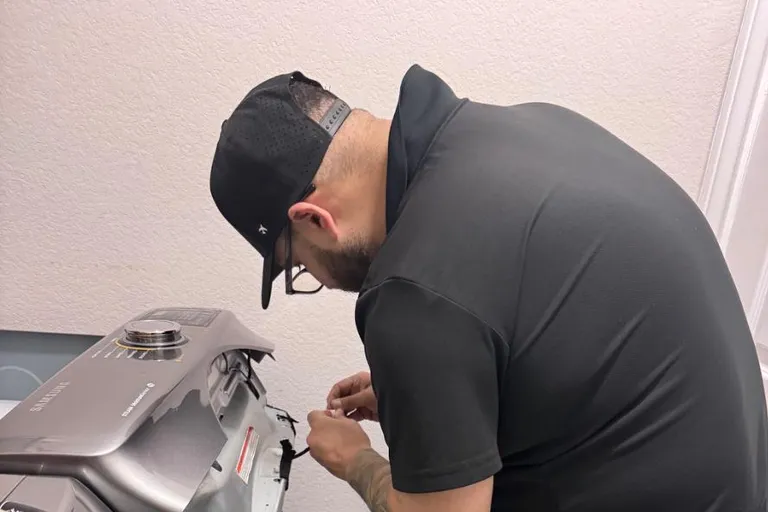
Some pauses are normal. A modern washer may stop briefly while it senses the load, redistributes clothing, heats water, or waits for suds to settle. A problem is more likely when the machine stays paused, repeatedly returns to the same point, displays an error, leaves water in the tub, or requires a power reset to continue.
Before guessing at a control board or ordering a lid lock, note what the washer was doing immediately before it stopped. Did it fill but never agitate? Did it wash and then stop with water still inside? Did it begin spinning, shake, and pause? Those details separate several faults that can look identical from across the room.
Start with safety and protect the laundry area
If water is leaking, turn off the washer's supply valves when they are accessible and safe to reach. Disconnect power only if you can do so without standing in water or touching a wet plug or receptacle. Stop using the machine if you smell burning insulation, see smoke or sparking, hear severe metal-on-metal impact, or the circuit breaker trips repeatedly.
Common reasons a washer stops before the cycle finishes
The cycle is paused for load sensing or redistribution
Short pauses can be part of normal operation, especially with high-efficiency models. An oversized comforter, a single heavy item, or clothing gathered on one side can keep the washer from reaching spin speed. The machine may add water, tumble, or pause while trying to rebalance the load. If the manual permits it, cancel the cycle, wait for the lock to release, and redistribute the items evenly. Do not force the lid or door open.
Water is not entering at the expected rate
A closed supply valve, kinked inlet hose, clogged owner-accessible inlet screen, low household pressure, or failed inlet valve can make a washer wait during fill or rinse. Confirm that both supply valves are fully open and that the hoses are not sharply bent. Follow the model's manual before cleaning a screen; some screens are not meant to be removed by the owner.
The washer cannot drain
Many washers will not advance to full-speed spin until the control detects that enough water has left the tub. A kinked drain hose, blocked standpipe, clogged pump filter on models with an owner-accessible filter, obstructed pump, or electrical fault can stop the cycle with wet clothes and standing water. Check only the hose routing and any filter procedure specifically described in the manual. Water inside the machine can spill quickly when a hose or filter is opened.
The lid or door lock is not being confirmed
A washer can fill or begin a cycle and then stop if it cannot confirm a secure lock. Look for clothing caught between the door and seal, detergent residue around the latch, or a lid that does not sit squarely. Do not slam the door or push a tool into the latch. A broken strike, worn lock, loose connection, alignment issue, or control fault can require model-specific testing.
Power is interrupted
A loose plug, worn receptacle, overloaded circuit, damaged cord, or household power problem can make the display go blank or restart. Make sure the washer is plugged directly into the type of grounded outlet required by its manual; do not use an extension cord. If the breaker has tripped, do not keep resetting it. Repeated trips need qualified electrical or appliance diagnosis.
Excess detergent creates a long pause
Too much detergent—or detergent that is not appropriate for a high-efficiency washer—can produce excess suds. Some machines extend the cycle or pause while attempting to clear them. Use the detergent type and amount specified by the washer and detergent manufacturers, accounting for load size, soil level, and water conditions.
A sensor, motor, wiring, pump, or control fault interrupts the sequence
When the easy external checks do not explain the stop, the machine may not be receiving or proving the signal needed for the next step. Different models monitor water level, motor movement, basket speed, temperature, lock position, and drainage in different ways. An error code is useful evidence, but it often identifies the affected system rather than one guaranteed failed part.
Safe checks to make before scheduling service
- Record where the cycle stops. Note the selected cycle, minutes remaining, display message, sounds, and whether water remains in the tub.
- Wait through a normal pause. Check the manual for cycle behavior before canceling. Some sensing and balance pauses last longer than expected.
- Check the load. When the machine is safely stopped and unlocked, remove excess items or redistribute a single heavy item.
- Inspect external hoses. Look for kinks, crushing, leaks, or a drain hose pushed farther into the standpipe than the installation instructions allow.
- Confirm water and power. Verify open supply valves, an intact cord, and a normal display. Do not remove outlet covers or repeatedly reset a breaker.
- Save the error code. Photograph the display before unplugging the washer. Check the code in the official manual for the complete model number.
If the manual provides a control reset, follow that exact sequence once. A reset may clear a temporary software state, but it does not repair a blocked pump, weak connection, failing lock, or recurring power fault. If the washer stops again, the repeatable point in the cycle is valuable diagnostic information.
What a washer technician may test
A technician should begin by reproducing or confirming the symptom and reviewing stored errors when the model supports them. Depending on the stop point, diagnosis may include water supply and valve operation, drain time, pump condition, pressure sensing, lid or door lock feedback, motor movement, basket speed, wiring connections, and control output. Not every component needs testing on every visit.
Bring the complete model number and any photos or video of the failure. Also note whether the problem happens with every load, only bulky items, one particular cycle, hot or cold water, or after a recent move or hose installation.
Washer repair for Humble and nearby communities
Quality Repairs helps homeowners in Humble, Atascocita, and Kingwood diagnose washers that pause, fail to drain, do not complete spin, or stop with an error. Review our washer repair service or request an appointment online.
The diagnostic visit is $79.99 and is credited toward an approved repair. Have the model number, error code, cycle name, and a description of the last completed step ready when you call.