
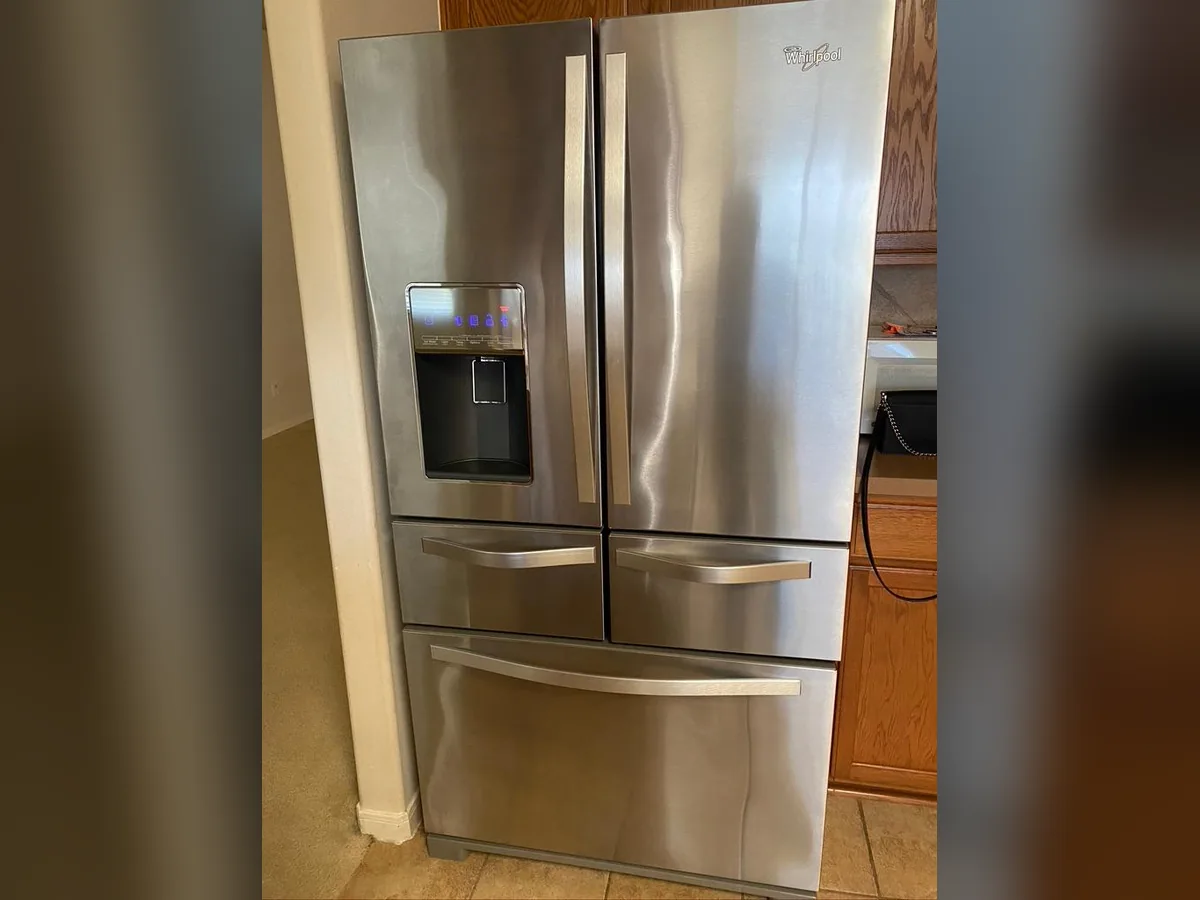
A refrigerator can fit between the cabinets and still be wrong for the kitchen. Doors may strike a wall, drawers may not open fully, the case may project farther than expected, or the delivery crew may be unable to turn through a hallway. The safest buying plan checks three things before checkout: the installation opening, the operating space around the appliance and the route from the entrance to the kitchen.
Write down your measurements and compare them with the exact model's specification sheet and installation instructions. Do not rely on a showroom tag, a nominal width such as "36-inch," or measurements from a visually similar model.
Build a three-part refrigerator fit plan
1. Measure the cabinet opening in several places
Measure width near the top, middle and floor. Measure height at both front corners and toward the back. Measure depth from the back wall to the front edge of the counter, accounting for baseboards, trim, outlets, water valves or other projections. Older floors and cabinets are not always square, so the smallest usable measurement is the one that limits the appliance.
Also decide what "depth" means for your kitchen. A counter-depth model can align more closely with nearby counters, but handles and doors may still extend beyond them. Product specifications often separate case depth, depth without handles and total depth with doors or handles. Compare the dimension that describes the installed appliance, not the most flattering number.
2. Test the space needed to use it
Refrigerator doors need room to swing past cabinet faces and adjacent walls. Some shelves or crisper drawers cannot be removed unless a door opens wider than 90 degrees. French-door and side-by-side layouts may reduce the reach of each door, but they do not eliminate hinge-side clearance. Map the open doors with painter's tape on the floor, and check whether they would block a walkway, island, pantry door or dishwasher.
Use the manufacturer's dimension drawing to confirm door width and depth at the stated opening angles. If the refrigerator sits beside a wall, check the hinge-side requirement carefully. A unit that technically enters the opening may need to stand farther forward to let bins and drawers clear that wall.
3. Measure the complete delivery path
Measure the narrowest exterior door, hallway, stair landing and kitchen entrance. Note tight corners, low ceilings, handrails and removable interior doors. Compare the route with the packaged and unpackaged dimensions listed by the seller or manufacturer, and ask who is responsible for removing appliance doors if that is required.
Protect flooring and plan where the old refrigerator will go before delivery day. Do not improvise by lifting a large appliance over an obstruction or disconnecting a water line or outlet you cannot access safely. A qualified installer should handle conditions outside the manufacturer's normal instructions.
Use the exact installation instructions for clearances
Refrigerators release heat and need the clearances specified for that model. A generic gap copied from another appliance may be too small or unnecessarily large. Check the installation guide for space above, behind and at both sides, then include those allowances in your opening calculation.
Look at the outlet and, for a model with water or ice features, the shutoff valve. They must remain accessible and should not be crushed behind the cabinet. Never use an extension cord, modify a plug or force a refrigerator into a space where the cord, water line or ventilation path will be pinched.
Compare ownership cost, not only purchase price
The yellow EnergyGuide label provides model-specific energy-use and estimated operating-cost information, plus a comparison range for similar products. Use it to compare models in the same category and size. The dollar estimate depends on the electricity rate printed on the label, so annual energy use is often the cleaner figure for comparing two refrigerators.
ENERGY STAR notes that larger refrigerators generally use more energy and recommends choosing an appropriate size instead of paying to cool unused space. Door arrangement, insulation, compressor design and controls can also affect consumption. An ENERGY STAR certification is useful evidence of efficiency; it does not by itself prove that a model fits your kitchen or meets your storage habits.
Choose features you will maintain
Extra doors, convertible compartments, displays and through-door dispensers may be convenient, but every feature adds cleaning steps and possible service points. Choose them because your household will use them, not because they look impressive in the showroom. Before buying a water-dispensing model, check filter cost and availability, water-line requirements and whether the dispenser area is easy to clean.
For a built-in ice maker, review bin access, filter requirements and the owner's maintenance schedule. A refrigerator's built-in ice maker is part of refrigerator service; a standalone undercounter ice machine is a different type of appliance with its own installation and maintenance needs.
Interior layout matters more than a single capacity number. Bring the dimensions of a large tray, gallon container or other item you store often. Check whether shelves adjust without blocking vents and whether drawers can be removed in the planned door position.
Do not replace a refrigerator based on one symptom
If this purchase is being driven by a warm compartment, frost, noise or leaking water, one symptom does not prove the appliance is beyond repair. Possible causes can include settings, blocked airflow, dirty accessible condenser areas, door-seal problems, fans, defrost components, sensors, controls, a drain or water-supply issue, or a sealed-system fault. The age, condition, diagnosis, repair estimate and expected ownership plans all matter.
Begin with the safe observations in our refrigerator not cooling guide. Do not remove panels, test energized circuits or attempt refrigerant work. Quality Repairs provides refrigerator diagnosis and repair when a professional evaluation would help you compare repair with replacement.
A refrigerator buying checklist
- Record the smallest width, height and depth of the opening.
- Add every model-specific ventilation and hinge clearance.
- Confirm doors, bins and drawers can open in the real kitchen layout.
- Measure the narrowest point and every turn along the delivery path.
- Verify outlet, cord, water connection and shutoff-valve access.
- Compare EnergyGuide energy use among similar-size models.
- Review filter costs, cleaning tasks and feature maintenance.
- Save the specification sheet, receipt and installation documents.
Local refrigerator help in the Lake Houston area
Homeowners in Kingwood and other confirmed Quality Repairs service areas can call (832) 242-9916 or request service online. The diagnostic visit is $79.99 and is credited toward an approved repair. Quality Repairs uses three-hour arrival windows and calls about 30 minutes before arrival.